
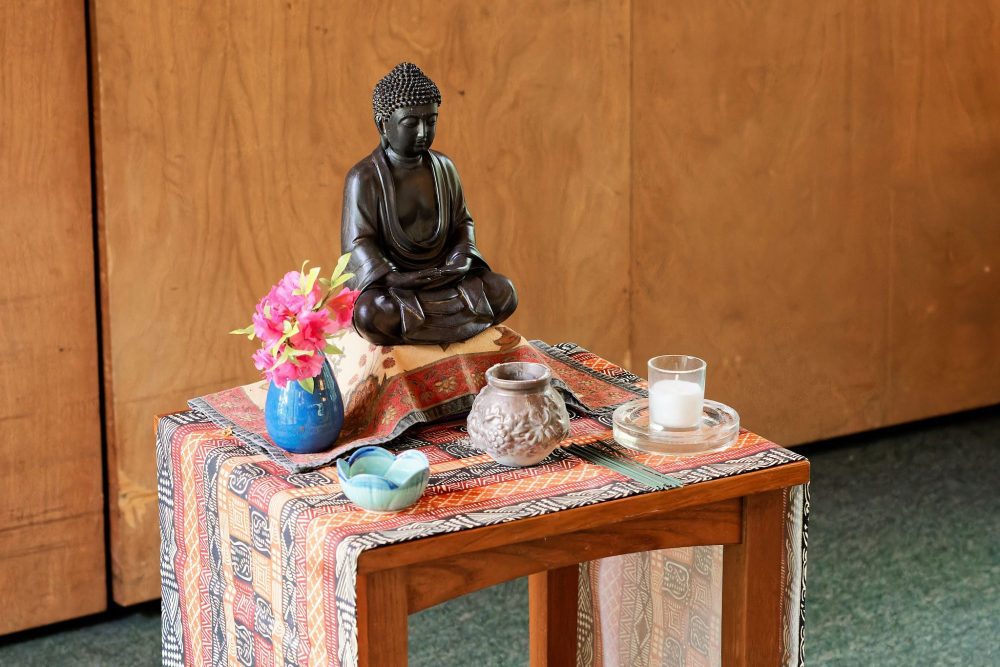
When we sit zazen together as a sangha—Wednesday nights, or longer zazenkai and sesshin retreats—we follow many of the traditional Zen forms. This is a brief summary of how we practice.
We offer, and strongly encourage, an Introduction to Zen Practice for those who are new to Zen, or who have practiced before but would like to be familiar with our sangha’s forms.
Arriving at the Zendo
Please arrive early to find a seat in the zendo. Take off your shoes and place them in the designated spot. Silence your phone. Select a cushion (zafu), seiza bench, or chair per your preference. Briefly go into the zendo without any bows and and place your selection on an empty mat (zabuton). You can store valuables behind the screen at the front of the zendo. Once you’re set up, leave the zendo so you can bow in formally. Bow in and take your seat by five minutes before the first bell.
Signup sheets for one-on-one teacher meetings (dokusan) may be available on the table. Feel free to sign up, especially if you are new.
If you arrive late, please wait outside of the zendo on one of the benches or chairs in the main foyer until the next walking mediation (kinhin) period starts. Set up your cushion and join the zendo during kinhin. If you need to leave early, use the restroom, or change your seat, please do so during kinhin.
Practice Period
When we gather for Zen practice, we open with forms and chants. We sit three 25-minute zazen periods with kinhin between. After the zazen periods, we end with closing chants and a final bow.
Opening Chants
Group practice begins with an incense offering, bell chants, and traditional gathas. Please follow along using the laminated chant card that has been tucked under your mat or chair. Our program chants are on our chants page. When you are done chanting, put your card away to keep the zendo tidy.
Sitting Zazen
Participants are welcome to sit on a cushion (full-lotus, half-lotus, quarter-lotus, or seiza), a bench, or a chair, whichever is most comfortable. Please avoid fidgeting, but you can mindfully adjust your posture if need be.
Zazen periods may be silent, or include a Dharma talk, chant practice, or dokusan.
Walking Kinhin
Kinhin is a mindful walking meditation. Kinhin gives you the opportunity to get circulation in your legs moving again, but it is not a stroll or a break in practice of Zen. Walk mindfully in the kinhin line, maintaining an arms length distance from the person in front of you. For detailed information on how to walk kinhin and the clapper signals, refer to our kinhin page.
There will be a moment to move and stretch before kinhin. Please stand carefully if your foot or leg is asleep. If walking is uncomfortable or difficult, you can opt out of kinhin.
Dokusan
If a teacher is offering dokusan, the lead student (shuso) will announce the start of the dokusan period and remind everyone of the form for entering and leaving the dokusan area. Students go one at a time in the order specified by the shusho. Listen carefully to the order of the students and pay attention to the person ahead of you so you know when it’s your turn.
Time for dokusan is very limited on Wednesday nights so we place a signup sheet outside of the zendo. Please feel free to sign up – using a list simply removes the guesswork and is not meant to limit your access to our teachers.
To learn more about the Zen tradition of dokusan, read our dokusan page. It also has directions on how to request dokusan over Zoom.
Chant Practice
Chanting is a part of Zen Buddhist practice, of wholeheartedly using voice and body to practice in harmony, with your own body and with other voices. When chanting with others, pay attention to both blending your voice with others, yet expressing the fullness of the chant in your own breath and body.
The chant leader will prompt you to take out your chant book when it is time to chant, usually during the third zazen period.
Closing
Please have your chant card on hand for the closing. We will recite the Four Vows immediately after the third sit.
Longer programs like zazenkai and sesshin will conclude with a “Way of Council,” a period of reflection which will be explained, followed by an additional incense offering.
After the end of the program, any help packing up the zendo is greatly appreciated.